

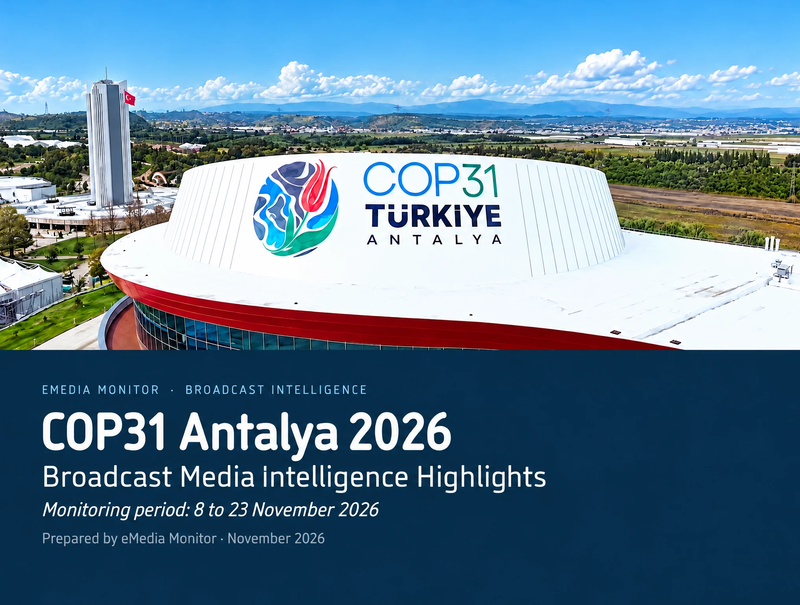
Fossil fuels sank the summit, yet the oil majors were barely named. Here’s what 6,581 broadcast segments reveal about who was in the COP31 story, and who was missing from it.
25 Nov 2026 - eMediaMonitor
COP31 ended in Antalya on Sunday 22 November, two days late and without a deal, the first time since 2009 that the UN climate summit closed with no agreed outcome. The sticking point was a single omission: the draft text did not mention fossil fuels. That omission ran through the whole fortnight on TV and radio. Fossil fuels dominated the coverage, yet the oil majors at the centre of the issue were barely named, while the US President stayed away and was named more than anyone.
TV and radio are still where much of the world follows a summit like this. To map the stories, companies, individuals and organisations that defined COP31, eMM monitored 270 TV and radio channels in 77 countries and 32 languages, continuously from 8 to 23 November. COP31 appeared on 216 of them, in 65 countries and 23 languages, giving 6,581 broadcast segments (one story on one channel, counted once however often it was repeated) and 10,821 airings in all.
eMM’s in-house technology transcribed every segment in its own language. Rather than searching for a pre-set list of names, it identified every entity named and the common storylines running through the coverage, and tagged the editorial tone of each segment, giving an open, unfiltered picture of the conversation and how it was framed.
The fossil-fuel debate was the biggest storyline of the summit, running through 3,249 segments, or 49% of all coverage. It wasn’t always that way. For the first twelve days it hovered at around a third of each day’s coverage, dipping to 29% on Friday 13 November. That changed on Thursday 19 November, when the summit’s draft agreement was published with no mention of fossil fuels. The debate jumped to 73% of coverage on the scheduled closing day and 82% on the Sunday the talks collapsed.
Other storylines ran alongside it: emissions and the 1.5°C limit (35% of segments), the host and presidency (33%), climate finance (31%), the presidency’s own “35 by 35” electrification target (25%) and adaptation and loss (21%). The last was led by the Pacific Island states, among the countries most exposed to rising seas and among those who refused to sign the final text.
Each storyline carried its own tone. The fossil-fuel debate was the most negative (45% of segments negative, 11% positive), with protests and civil society close behind (44% negative). The brighter stories belonged to the host: electrification had the most favourable balance (30% positive, 20% negative) and the host and presidency the highest positive share (33%). Climate finance sat in between, and was where companies were most likely to earn a positive mention. Coal was named in 1,208 fossil-fuel segments. The oil companies, as we’ll see, hardly were at all.

The most-named person in COP31 coverage wasn’t even in Antalya. The US sent no delegation for a second year, yet Donald Trump was named in 470 segments, slightly ahead of UN Secretary-General António Guterres (435) and host President Recep Tayyip Erdoğan (390).
Behind them came UK Prime Minister Andy Burnham (350), COP31 President Murat Kurum (303) and Australia’s Chris Bowen (281), who led the negotiations. The two men running the summit were named less often than the one who stayed away. The absences weighed on the tone too: 34% of segments on absent leaders and the US were tagged negative.
Absence worked the other way too. US coverage was heavily radio-led, and the main TV networks largely stayed away from the story. Fox News, the most-watched US cable news channel, mentioned the summit twice in sixteen days, both times in passing.

73 organisations were named alongside the summit. Institutions led the way: the IEA (54 segments), the World Bank (50) and the WMO (44). Big tech made it in too, with Microsoft (25), Apple (17), Google (14) and Meta (13) all named at a climate summit, mostly for their environmental footprint.
Türkiye’s partner companies, including Koç Holding, Enerjisa, Garanti BBVA, Ziraat Bankası and Türk Telekom, were the most visible brands, named in 194 segments between them. Much of that came through sponsor idents and executive interviews on Bloomberg HT, A Para and CNBC-e. This is where it pays to know whether a mention was earned or paid for, and eMM’s ad detection can separate the two.
Climate finance put the development lenders on air too: the World Bank (50), the Asian Development Bank (18), the EBRD (13) and the AIIB (12). Much of this followed a single announcement on 12 November, when Türkiye signed ten agreements worth $5.1 billion with the World Bank, the Asian Development Bank, the AIIB and the Islamic Development Bank. Finance was only the fourth-largest storyline, yet it carried 184 company and bank mentions, against just 126 in the far bigger fossil-fuel debate.
ExxonMobil, BP and Shell were named in just five segments between them. The argument that sank the summit ran for sixteen days as the most negative storyline on air, and the sector’s story was told entirely by others.
Even where oil made the news, the companies did not. The UK’s approval of the Rosebank oilfield drew 38 segments, discussed as a licensing decision without its operator, Equinor, being named. A search for brand names alone would have missed every one of them. Reading every transcript found them all.

COP31 shows how little control an organisation has over whether it is named at a global event. A sponsor appeared through its idents and executives, a bank through what it signed, and a tech company through criticism of its footprint. An oil company, at the heart of the issue, was barely named at all, and the summit’s most negative storyline played out without it.
For a communications team, each of those is a different risk and a different opportunity. At a summit followed in 65 countries, a mention on a Turkish business channel can easily go unseen. So can an absence, and the story gets told regardless.
This is exactly what broadcast intelligence is for. eMM’s AI-driven systems, developed and operated in-house, monitor TV and radio in real time across 94 countries and more than 40 languages. Natural language processing, auto translation and auto summary turn every segment into searchable text, while logo recognition and ad detection show when a brand appears on screen, not just when it is spoken. Backed by nearly 20 years of specialist broadcast expertise, that turns complex audiovisual coverage into structured, reliable data that communications teams can act on, whether they were named or not.
Get your free copy of the full COP31 insight report, with the storylines, the people, the 73 organisations named on air and the markets where the story played. Reach out via the contact button, or email us at sales@emediamonitor.net.
eMediaMonitor