

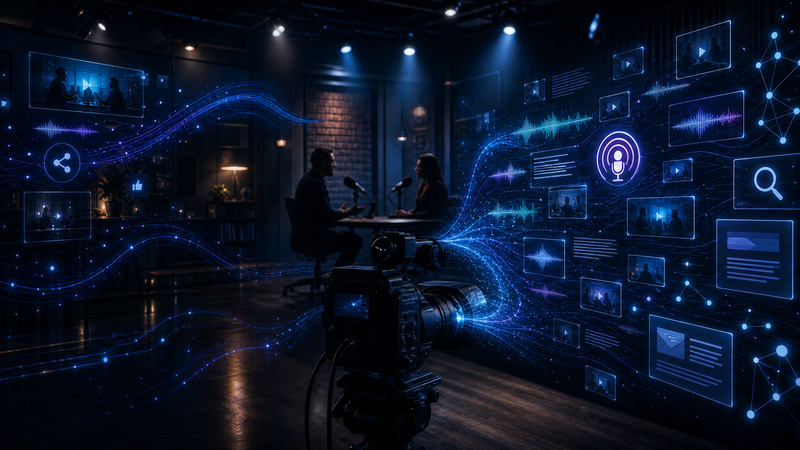
When the red light goes off, the broadcast story is just beginning
What happens after a broadcast interview ends?
That was one of the big questions explored in a recent eMedia Monitor podcast, where communications measurement specialist Steph Bridgeman spoke with journalist, media trainer and Clapperton Media Training founder Guy Clapperton.
Their conversation looked at how broadcast media is changing, and what that means for spokespeople, PR teams, media trainers and measurement professionals.
Because broadcast is no longer just about the moment someone appears on TV or radio. Today, an interview can quickly become a podcast clip, a YouTube video, a social post, a transcript, a newsletter item or a search result. It can be watched, listened to, read, shared and revisited long after the original recording has ended.
Preparing a spokesperson for the interview is still vital. But it is only part of the job. Communications teams also need to understand what happens to that content afterwards: where it travels, how it is understood, and what impact it has.
Guy’s message was clear: broadcast communication is no longer just about performing well in the moment. It is about understanding the full life of that moment before, during and after it is aired, published or shared. We’ve pulled out the key themes from the conversation below.
Broadcast used to mean TV and radio. Now, the lines are much blurrier. Podcasts, video podcasts, visualised radio, YouTube interviews and short social clips have all changed how audiences consume broadcast-style content. Some people watch the full interview, some listen on the move, some read the transcript, and others only see a short clip in their feed.
For comms teams, this means monitoring needs to follow the content, not just the platform it first appeared on.
Guy’s view of media training was refreshingly simple. It is not about spin, avoiding questions or turning people into corporate robots.
It is about helping spokespeople communicate clearly and confidently: understanding the audience, avoiding jargon, answering the question, staying calm and knowing what message really matters.
The best interviews come from good preparation, but there is a balance to strike.
The aim is to sound prepared, not programmed.
One of Guy’s most striking points was that almost everyone is now a publisher.
A phone can turn a passing comment into a public moment in seconds, and spokespeople are no longer only visible in a studio or during a scheduled interview.
They can be clipped from webinars, panels, conferences, internal broadcasts, informal videos or social content.
A moment can become media, a clip can become coverage, and a comment can become searchable.
A broadcast moment may not reach its full value when it first airs.
It might build impact later through social sharing, YouTube views, podcast clips, newsletters, internal updates, search visibility or follow-up coverage.
That is why measurement should not stop at transmission; it needs to show how the content lived, moved and landed.
Who saw it afterwards, what was shared, did the message remain intact, and did the tone change in a different context?.
Captions, subtitles and transcripts are often talked about as accessibility tools, and rightly so.
They make broadcast content more inclusive for people who are deaf or hard of hearing, watching without sound, scrolling in public, or engaging in a second language.
But they also make spoken content easier to find, understand, analyse, reuse and measure.
Accessibility is not separate from visibility; it strengthens it.
Coverage only matters if it supports the right outcome.
In the podcast, Guy shared the example of a small business owner who turned down a Financial Times profile because local media would have been more useful for reaching actual customers.
The lesson is a useful one: the biggest media opportunity is not always the best media opportunity.
This is where broadcast monitoring adds real value: not just by tracking volume, but by helping teams understand context, relevance and impact.
The biggest takeaway from Steph and Guy’s conversation is that broadcast content is no longer a single event. It is a living asset.
It can be aired, clipped, captioned, transcribed, searched, shared, analysed and rediscovered. It can reach one audience in the moment and another days, weeks or months later. It can support campaigns, shape reputation, influence stakeholders and show how messages are really landing.
That is why the red light going off is no longer the end of the story.
For communications teams, the question is no longer just: did we appear on broadcast media?
The better questions are: where did the content go next? How was it understood? What message travelled furthest? And can we see the full picture?
In modern broadcast, the interview is only the first transmission. The real value lies in understanding what happens after it.
Based on insights from a recent eMedia Monitor webinar featuring journalist, podcast interviewer and award-winning media trainer Guy Clapperton in conversation with media intelligence consultant Steph Bridgeman.
eMediaMonitor